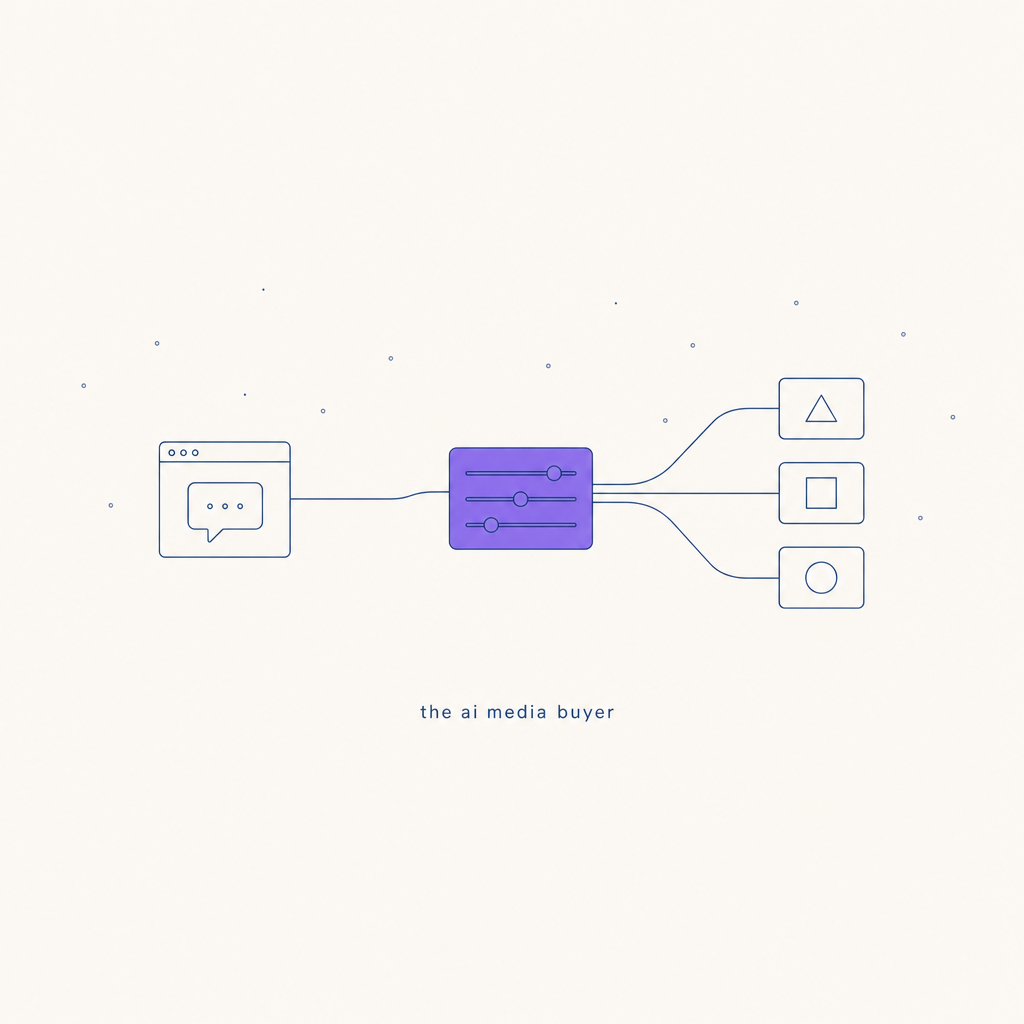
Meta Just Launched an AI for Media Buyers. The Content Layer Is the New Bottleneck.
Meta opened its ad infrastructure to AI agents on April 29, 2026. A media buyer's day-job can now be done by Claude in 10 minutes. The bottleneck for SME advertising just shifted to creative production — and that is the gap Rheos is built to close.
Meta Just Launched an AI for Media Buyers. The Content Layer Is the New Bottleneck.
On April 29, 2026, Meta did something that changes the economics of paid social for small businesses.
Meta launched the Meta Ads MCP server — an open-beta interface that lets AI assistants like Claude and ChatGPT manage ad accounts directly through natural language. 29 tools. 7-10 minute setup. Sub-minute data freshness. The launch went almost unnoticed outside marketing-tech circles, which is fine, because most of the people it is going to displace had not heard of MCP a month ago.
The headline for SME founders is simpler than the technical detail. The thing you used to pay an agency £1,500 a month to do — the routine campaign management — can now be done by an AI agent for the cost of a Claude subscription. That work is not strategic. It never was. It was reading the dashboard, pausing underperforming ads, adjusting bids, swapping creatives that fatigued, and writing a monthly report.
All of that is now table stakes for a competent AI agent.
So if the campaign management itself is no longer the bottleneck, what is?
It is the same thing it has always been, except the supply side is now starved: on-brand creative.
The short version
Meta's new Ads MCP turns Claude into a media buyer for £20-40 a month. The agency moat for routine ad management is gone. The new bottleneck is producing enough on-brand creative variations to feed Meta's ad model. That is the layer Rheos is building for.
What the Meta Ads MCP actually does
If you have not come across MCP before, the short version: it is an open standard (introduced by Anthropic in late 2024) for letting AI assistants take real actions in real systems. Claude or ChatGPT no longer just talks about your ad campaigns. It logs into them and changes them, with proper authentication and audit trails.
Meta's implementation exposes 29 specific tools. The notable ones:
get_campaigns,get_ad_sets,get_ads— read the current stateget_insights— pull performance data with sub-minute freshnessupdate_ad_set,update_budget,pause_ad,resume_ad— change campaignscreate_campaign,create_ad_set,create_ad— spin up new structuresanalyse_creative_fatigue— flag ads losing performanceget_audience_insights— pull audience-level data
A user can connect their Meta ad account to Claude in 7-10 minutes (OAuth + ads_management permission), then just type natural language instructions. "Pause my worst-performing ad set in the lookalike campaign and move that budget to the top creative." "Show me which creatives are fatiguing and propose new variations." "What was my CPA last week vs the four weeks before?"
Third-party AI agents built on top of the MCP have started reporting concrete numbers. Ryze AI, an MCP-compliant agent for Meta, claims an average 3.8x ROAS within six weeks and pauses underperforming ads roughly 48 hours faster than a human media buyer would. Another fitness brand reported a 15% monthly revenue increase from running Claude with the Meta MCP for routine audits and budget rebalancing.
These are best-case numbers, not averages. But the direction of travel is clear, and the floor — what an SME with no ad expertise can now do — is far higher than it was 30 days ago.
What this kills
Be honest about what this displaces.
Routine campaign management as a service. The media-buyer-in-a-box service that agencies have been selling to small businesses for £1,500-£3,000 a month. Reading the dashboard, pausing bad ads, swapping creatives, writing a monthly PDF. An AI agent does this faster, doesn't sleep, and costs £20-40 a month.
Junior media buyer roles in agencies. The first-year role of "checking dashboards, pausing things, applying templates, generating reports" is the most automatable role in marketing. Agencies will keep the senior strategists and the creatives. The middle layer is in trouble.
Audit consultancies. "I will do a free Facebook ad audit and tell you what is wrong" was a viable lead generation tactic. Claude with the Meta MCP can now do that audit in 90 seconds. The business model that depended on the audit being expensive and slow is over.
Half the value of the agency dashboard tools. Tools that exist to wrap Meta Ads Manager with a slightly nicer UI and an automated insight engine just had their main value compressed by an AI assistant that reads the underlying API directly.
This is not a future scenario. It is what April 29, 2026 set in motion.
What this does not kill
The same forces that compress the routine work amplify the value of the upstream work.
Strategy. Deciding what to advertise, to whom, with what offer, on what channel — Claude can suggest options inside an existing context, but it does not know your business, your margin structure, your customer LTV, or your founder intuition. The senior strategist's job is safer than ever.
Brand and creative direction. Meta's GEM model (the foundation model that powers ad ranking now) rewards creative variety. It is no longer enough to have one ad. You need ten variations across image, video, and copy. Generic stock-image variations produce generic results. The brand-level decisions about what your business looks and sounds like are now the single biggest lever you control.
Content production at the volume the new system requires. This is the core point. AI ad management consumes creative at a much higher rate than human ad management did, because the AI agent can spin up new ad sets, test new audiences, and request new creative variations far faster than the human did. The old workflow was: brief a designer, wait two weeks, get one set of assets, run them for a month. The new workflow is: spin up an MCP-driven test, find a winning angle within 72 hours, then need ten variations on that angle by Friday.
Most agencies and SMEs are nowhere near tooled for that.
The new agency stack
The agency stack of 2024 looked like this:
- Strategy lead (senior person)
- Account manager (mid-level relationship)
- Media buyers (1-3 junior people running campaigns)
- Creative team (designer + copywriter + sometimes a video editor)
- Reporting analyst
The agency stack of 2026 looks more like:
- Strategy lead (same role, more leverage)
- Account manager (same role, less time spent on reporting)
- MCP-driven media buying (an AI agent with sensible guardrails)
- Content production layer (a tool or platform that turns brand context into 10x the creative output)
- Senior creative direction (smaller team, higher leverage)
The middle squeezes. The top and bottom retain or grow.
For SMEs running this in-house, the structure is the same but smaller. Founder + content tooling + AI ad agent.
Why we are building Rheos for this
Rheos was always built to solve the content-production half of social media for small businesses. Our original framing was "your website knows what your brand is, why are you writing every social post from scratch?". That has not changed. What has changed is the urgency.
Two reasons.
One: the ad side now consumes creative faster than the organic side. Until April 2026, the bottleneck for SME advertising was budget and targeting expertise. Both of those are now solved or commodified. Creative variety is the only remaining lever, and most SMEs cannot produce ten on-brand image variations and three video variations a week without a tool doing most of the heavy lifting.
Two: the buyer changed. Until 2026, the user of a social media tool was a human marketer. From 2026 onward, increasingly, the user is an AI agent — either a media buyer's Claude session or an SME founder asking ChatGPT to "draft me five variations for next week's Instagram and LinkedIn". Tools that were built for humans clicking buttons are not optimised for that interface. Tools that expose proper APIs and MCP-friendly endpoints are.
We have already shipped an MCP server for Rheos. It exposes 16 tools today: brand context, post drafting, image generation, scheduling, publishing, analytics. An AI assistant can already, today, draft an on-brand carousel in your voice, generate an image to match, schedule it for next Tuesday at 2 PM, and tell you which post in your last 30 performed best. Without you opening the dashboard.
The strategic bet underneath this is straightforward. Media-buying agents need a content layer. They will not produce on-brand creative themselves. Even GEM does not — it ranks and distributes creative, it does not create it. Some tool has to produce the on-brand variations the agent then spends. We want that tool to be Rheos.
What this means for SMEs in May 2026
If you currently have an agency running your Meta ads, ask them three questions:
- Are you using the Meta Ads MCP, or are you still doing routine campaign management by hand?
- How are you producing creative variety at the rate GEM rewards?
- What is your monthly retainer paying for that an MCP-driven Claude session could not do?
If the answers are weak, the right move is not necessarily to fire the agency. It is to renegotiate scope. Pay them less for routine management (which is now cheap) and more for strategy and creative direction (which is now scarce).
If you are running ads in-house, the highest-leverage hour you can spend this week is setting up the Meta Ads MCP with Claude or ChatGPT. The setup time is 7-10 minutes. Once it is connected, you can ask "what would you change about my campaigns this week" and get an actually useful answer based on real-time data.
And then the question becomes, as it always does for SMEs: where am I going to find the time to make ten new creative variations a week?
That is the gap we built Rheos to close. From £55/month, flat, for SMEs running paid alongside organic.
Frequently asked questions
Summary
Meta's Ads MCP turns Claude into a media buyer in ten minutes. Routine campaign management as an agency line item is over. Strategy, creative direction, and on-brand content production at scale are now the only parts of the stack that retain value.
Rheos sits on the content layer of that new stack. The point of building an MCP-friendly content tool now is that the buyer of social-media tooling, in 2026 and beyond, increasingly is not a human clicking buttons — it is an AI agent doing the routine work for the human. We are building for that.
If you want to see what an MCP-friendly content stack looks like, try Rheos or check our MCP early access page.