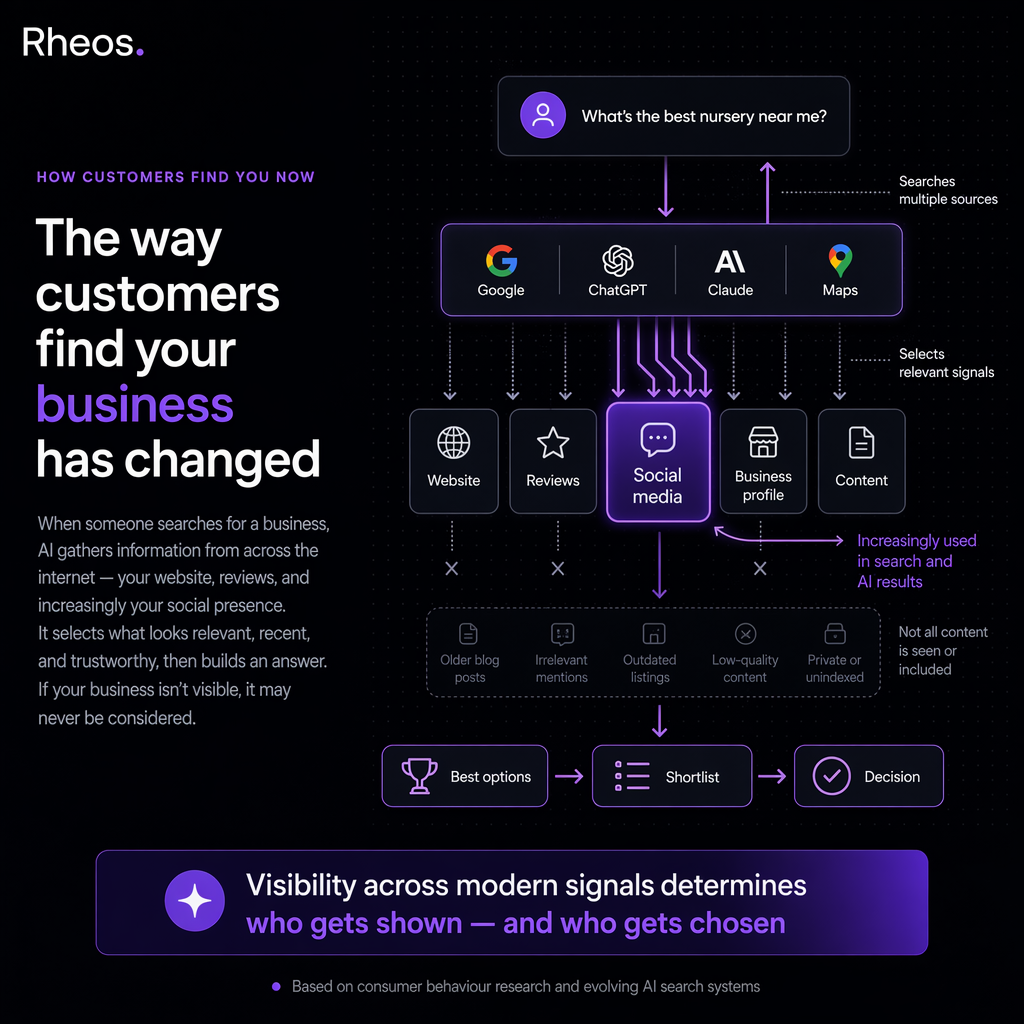
Why Social Media Is Now a Primary Citation Source in AI Search
Your website is no longer the most important component of online visibility. AI search engines now lean on LinkedIn, YouTube, Reddit, Instagram and TikTok to decide who to recommend. Here is the verified 2026 data and what it means for SMEs.
Why Social Media Is Now a Primary Citation Source in AI Search
Your website is no longer the most important component of your online visibility.
AI search engines — ChatGPT, Google AI Mode, Gemini, Microsoft Copilot, Perplexity — are looking elsewhere to decide whether you are worth recommending. They are looking at LinkedIn. They are looking at YouTube. They are looking at Reddit. They are reading Instagram profiles, scanning Threads, and parsing TikTok captions.
When someone asks an AI which social media tool is best for a small business, or which nursery in Nottingham is highest rated, or which accountant they should hire, social media is increasingly part of the answer.
This is not a soft trend. It is a measurable shift in citation hierarchies that has accelerated dramatically in the last six months. It is also the next stage of GEO (Generative Engine Optimisation) — the practice of optimising content to be cited by AI answer engines rather than ranked by Google. Below is the verified 2026 data, drawn from primary research at Profound, Peec AI, Adobe, Meta and Pew, with sources at the bottom of the page.
What this article covers
Verified 2026 statistics on which social platforms get cited by AI engines most often, what content within each platform AI prefers, and what this means for small and medium-sized businesses trying to get found in answer engines.
The Headline Numbers
- LinkedIn's rise
- #11 → #5LinkedIn's rank among most-cited domains in ChatGPT responses, Nov 2025 → Feb 2026
- Source: Profound, Feb 2026
LinkedIn is now the #1 most-cited domain for professional queries across ChatGPT, Google AI Mode, Gemini, Microsoft Copilot and Perplexity.1 In the three months from November 2025 to February 2026, it climbed from approximately #11 to #5 on ChatGPT overall — more than a 2x increase in citation frequency in a single quarter.2
- Reddit on Perplexity
- 46.7%of all Perplexity citations point to Reddit threads
- Source: Peec AI, 2026
Reddit dominates Perplexity. 46.7% of all Perplexity citations point to Reddit threads.3 On Google AI Overviews, Reddit accounts for roughly 21% of citations.4 Between March and June 2025, Reddit's citation rate inside Google AI Overviews surged 450%.5
- YouTube in AI answers
- 29.5%of all AI citations across major platforms reference YouTube
- Source: ZipTie / Adweek 2026
YouTube accounts for around 29.5% of all AI citations across major platforms,6 and AI engines pick it 200x more often than any competing video platform — driven by Google ecosystem alignment, transcript quality, and structured metadata.6
In other words, when AI answers a question about your industry, the source it cites is increasingly social, not corporate.
The Librarian Has Changed Bookshelves
Citation
•In AI search, a citation is the URL the language model points to when it generates an answer. AI systems extract content from cited sources, paraphrase or quote them, and link the user to the original. The set of cited sources is the closest equivalent to a 'first-page ranking' in classical SEO.For 25 years, the model was simple: build a website, optimise it for Google, and you would get found. Google's job was to send people to your site so you could finish the sale.
AI engines do not work that way. They read every cited source, summarise the answer in their own words, and present a single response. The user often never clicks. 69% of searches now end without a click.7 The citation list at the bottom of an AI answer is the new search results page — and what gets onto that list is no longer dominated by traditional brand websites.
What gets onto that list, increasingly, is social.
Why AI Engines Prefer Social Content
Three structural reasons:
1. Real questions, real answers. Reddit, Quora and LinkedIn comments contain natural-language question-and-answer patterns. AI systems are trained to replicate exactly that conversational structure, so social content is a near-perfect training signal. Statistics inside content increase AI citation probability by 37%, and citing authoritative sources boosts it by 40% — both patterns that emerge organically in good Reddit threads and LinkedIn articles.8
2. Recency. 62% of AI Overview citations reference content updated within the last 90 days.8 A static "About Us" page from 2022 cannot compete with a LinkedIn post from last week.
3. Licensing deals. OpenAI signed a data licensing agreement with Reddit in May 2024.9 Google followed with a $60M annual deal.10 Reddit's AI licensing now generates approximately $130M per year and accounts for roughly 10% of Reddit's total revenue.9 Social platforms are no longer something AI scrapes incidentally — they are paid, structured ingestion pipelines.
The combined effect: when an AI engine has to choose between citing a brand's marketing page and citing a Reddit thread where five real users discussed the same product, it picks Reddit.
What This Means Platform by Platform
LinkedIn — the new #1 for professional queries
The most striking finding from Profound's research is not just that LinkedIn climbed the ranks, but what kind of LinkedIn content gets cited.
Over the same November 2025 to February 2026 window, posts and long-form articles rose from 26.9% to 34.9% of all LinkedIn AI citations. Profile pages collapsed from 33.9% to 14.5%.2
Translation: AI engines no longer care much about your static LinkedIn profile or your company page header. They care about what you and your team have published recently.
There is also a platform-specific split worth knowing:
- On ChatGPT and Google AI Mode, 59% of LinkedIn citations come from individual creators (personal profiles and personal articles). Company pages get the remaining 41%.11
- On Perplexity, that ratio inverts: 59% from company pages, 41% from individuals.11
For founders and small business owners, the practical conclusion is uncomfortable but clear: your personal LinkedIn presence now drives more AI visibility than your company page on the platforms most consumers use, and your company page drives more visibility on the platform researchers and journalists use.
A second finding sharpens the strategy. 95% of LinkedIn AI citations come from original content, not reshares.11 Posts in the 50–299 word range and articles in the 500–2,000 word range get cited most often.11 Engagement-hacking via reshares and quote-posts contributes essentially nothing to AI visibility.
Reddit — dominant on Perplexity, structural on ChatGPT
Reddit's role differs radically by platform:
- Perplexity: 46.7% of all citations.3
- Google AI Overviews: ~21% of citations.4
- ChatGPT: 2–3% of citations overall (Profound's analysis of ~700,000 ChatGPT citations, October–December 2025).12
The 2–3% figure on ChatGPT understates Reddit's true influence. Reddit's content was used to train GPT models via the WebText2 dataset, where Reddit posts with high community engagement received roughly 5x the weighting of average web text in training.13 Reddit's structural fingerprint is baked into ChatGPT's response style even when it is not the citation source.
When Reddit is cited, the specificity is striking: 99% of Reddit citations point to individual threads, not subreddit pages or user profiles.12 Brand subreddits and Reddit "presence" do not move the needle. Specific, well-answered threads do.
YouTube — won by transcript quality, not view count
YouTube citation patterns reveal a counter-intuitive lesson about AI discovery.
When ChatGPT cites YouTube, 85% of citations point to specific videos, with channel pages accounting for just 5%.12 More tellingly, Gemini cites videos with a median of just 4,394 views — about half the median view count of videos cited by ChatGPT.14
In other words: AI engines do not care if your video went viral. They care if the transcript is clean.
Optimising for AI visibility on YouTube looks different from optimising for the YouTube algorithm:
- Captions and transcripts with proper punctuation and speaker labels matter more than watch time.
- Descriptions structured around question–answer formats get cited more than promotional copy.
- Existing video libraries published years ago are still being newly cited as AI engines re-index back catalogues. Roughly 10% of citations come from legacy authority — videos optimised for traditional search before AI engines existed.14
Instagram — profile-driven, not Reels-driven
Instagram citation distribution is unusual: it is format-agnostic. Across ChatGPT citations, Instagram splits into profiles 44%, Reels 27.9%, static posts 23.5%.12
Compare this to YouTube (85% specific videos) or Reddit (99% specific threads), and the implication is clear: AI systems treat Instagram citation as a profile-level signal, not a content-level signal. They are answering the question "who is this brand?" rather than "what did they post?".
For Instagram, that means the foundations matter more than chasing format trends. A complete, well-maintained, professional profile with consistent posting across formats generates more AI visibility than a Reels-only strategy, even if Reels dominate Instagram's own algorithm.
TikTok — usage up, citation presence still thin
TikTok presents the most complicated picture. 49% of all US consumers now use TikTok as a search engine, up from 41% in 2024.15 Among Gen Z, the figure is 65%.15
But two important caveats:
- Only 25% of Gen Z users find TikTok effective as a search tool.15 Usage and effectiveness diverge sharply.
- The share of Gen Z saying they actively prefer TikTok over Google fell from 8% in 2024 to 4% in 2026.16
TikTok content also has minimal documented citation presence inside ChatGPT, Google AI Mode and Perplexity. Where TikTok matters is as a discovery surface for younger users searching trends, products and lifestyle content — and as a feeder of awareness that ends in a Google or ChatGPT search to confirm. TikTok's own AI Search features rolled out in 2026 may close some of the effectiveness gap, but for now, B2B and professional-services SMEs should not over-index on TikTok at the expense of LinkedIn or YouTube.
Threads, Bluesky, Mastodon — emerging, mostly absent
Threads search activity inside the platform itself is growing — average searches per user nearly doubled from 2 to 4 between 2025 and early 2026.17 But Threads, Bluesky and Mastodon all have minimal documented citation presence inside ChatGPT, Google AI Overviews or Perplexity.
This will likely change. Meta announced its Muse Spark model in April 2026, built inside Meta Superintelligence Labs, which surfaces content from Instagram, Facebook and Threads in its responses.18 Once Muse Spark is fully integrated into Meta AI's consumer products, Threads citation volume should rise. But as of mid-2026, citing-engine coverage of these alternative platforms is still an open frontier.
The Strategic Pattern
If you stand back from the platform-by-platform numbers, the structural pattern is consistent across every major AI engine:
What AI engines reward across all platforms
Specific, original, recent content from named individuals or organisations, with clean text representation, structured around real questions, and demonstrating community validation.
That is what gets cited. That is what gets recommended. And that is precisely what most SMEs are not currently producing — because the existing tooling assumes that "content" means a blog post on your own website.
What This Means for Small and Medium-Sized Businesses
The traditional SEO playbook — write blog posts, build backlinks, optimise meta tags — was built for an internet where Google was the bottleneck. AI search inverts that bottleneck. If your only digital presence is a website, you are visible to roughly one path through the modern answer engine, and that path is the one losing share fastest.
The new visibility surface looks like this:
- A founder presence on LinkedIn, posting original 50–299 word insights or 500–2,000 word articles weekly.
- A company LinkedIn page with structured content for Perplexity-driven research.
- YouTube videos with clean transcripts, even if view counts stay modest.
- An Instagram profile that is professionally maintained and posting consistently.
- Reddit and Quora answers posted by team members under real identities, with specific, substantive answers to real questions in your niche.
- Continued website content — but framed as the source-of-truth a trained AI cites rather than as the destination of a click.
This is a lot of surface area for a small business to maintain. It is also why most SMEs already feel that their social media presence is "another job they don't have time for". The math has not changed; the cost of not being there has gone up. For owners weighing up where to invest, our roundup of the best AI tool for the job and our breakdown of the leading scheduling tools for small business cover the practical decisions in more detail.
A Note on Methodology and Confidence
All numbers in this article come from primary research published in 2025 or 2026 by Profound, Peec AI, Adobe, Meta, Reddit, Pew, ZipTie, SparkToro and academic sources. Where two sources disagreed (most notably on Reddit's exact share of ChatGPT citations, where Profound's October–December 2025 dataset reports 2–3% and an alternative methodology cited via Search Engine Roundtable reports a higher share), we have shown the more granular and recently-published primary figure.
Citation patterns are also volatile. Peec AI's analysis of more than 1 million citations shows 40–60% monthly churn in which domains get cited for a given query.3 The implication is not "appear once and you are set" — it is "maintain consistent presence or watch your visibility drop".
Frequently Asked Questions
Where Rheos Fits
Rheos exists for the part of this problem that small business owners cannot reasonably solve by hand: producing on-brand content consistently across all five live platforms — LinkedIn, Instagram, Facebook, X, and Threads — from a single starting point, with more platforms on the roadmap. The visibility shift described in this article is a workload increase that very few SMEs have the time to absorb. Rheos turns the workload into ten minutes a morning. Try Rheos.
Summary
The website is no longer the only thing AI engines look at when deciding who to recommend. LinkedIn, YouTube, Reddit, Instagram and increasingly Meta's own platforms now hold a measurable share of citations, and that share is rising. SMEs that maintain consistent, original presence on those platforms get found. SMEs that don't, increasingly, do not.
Sources & Further Reading
- Profound — LinkedIn Is the Most-Cited Domain for Professional Queries in AI Search(2026)view source
- Profound — ChatGPT, Reddit and YouTube Citations Analysis (700,000-citation study)(2026)view source
- Peec AI — Citation Rate Benchmarks from Over 1 Million Citations(2026)view source
- Adweek — YouTube and Reddit Become Primary AI Search Engine Citation Sources(2026)view source
- ZipTie — Google AI Overviews Source Selection(2025)view source
- Averi.ai — LinkedIn Is the #1 Most-Cited Source in AI Search (Founder's Playbook, citing Profound)(2026)view source
- Adobe Express — Using TikTok as a Search Engine (2026 SurveyMonkey study)(2026)view source
- ALM Corp — Gen Z TikTok Google Preference Drop 2026 Data(2026)view source
- SparkToro — Search Happens Everywhere (analysis of 41 search-active websites)(2026)view source
- CBS News — Google–Reddit $60M AI Training Deal(2024)view source
- Columbia Journalism Review — Reddit Winning AI Licensing Deals(2025)view source
- Nova Southeastern University — AI and Reddit (WebText2 Weighting)(2024)view source
- Women in Tech SEO — Optimise Existing Videos for AI Search(2026)view source
- ALM Corp — ChatGPT Citations Study (44% First-Third Content)(2026)view source
- Meta — Introducing Muse Spark (Meta Superintelligence Labs)(2026)view source
Related reading
- Generative Engine Optimisation (GEO): why SMEs need to learn AI search
- How AI searches the internet for you
- How to make your brand visible online
Footnotes
-
Profound, LinkedIn Is the Most-Cited Domain for Professional Queries in AI Search — analysis of citation frequency across ChatGPT, Google AI Mode, Gemini, Microsoft Copilot and Perplexity (February 2026). tryprofound.com ↩
-
Profound, LinkedIn Citation Composition Changes November 2025 – February 2026 — same analysis, content-type breakdown. tryprofound.com ↩ ↩2
-
Peec AI, Citation Rate Benchmarks from Over 1 Million Citations — covers ChatGPT, Google AI Mode, Perplexity citation rates and 40-60% monthly domain churn (2026). peec.ai/blog ↩ ↩2 ↩3
-
ZipTie, Google AI Overviews Source Selection — Reddit, YouTube and Citation Distribution (2025). ziptie.dev ↩ ↩2
-
ZipTie analysis of Semrush data — Reddit's AI Overview presence rose from 1.3% to 7.2% in a single quarter, with a 450% surge between March and June 2025. ziptie.dev ↩
-
Adweek / ZipTie, YouTube and Reddit AI Search Engine Citations — YouTube citation share and 200x preference over competing video platforms (2026). adweek.com ↩ ↩2
-
SparkToro / SimilarWeb, 69% of Searches Now End Without a Click (2026). sparktoro.com ↩
-
ALM Corp study (cited in ChatGPT Citations Study: 44% First-Third Content) — 37% statistic-citation lift, 40% authoritative-source lift, 62% recent-content rule (2026). almcorp.com ↩ ↩2
-
Media and the Machine / CJR, Reddit's New AI Licensing Deal — total Reddit AI licensing revenue ≈$130M/yr; ≈10% of total revenue (2025). cjr.org ↩ ↩2
-
CBS News, Google–Reddit $60M AI Training Deal (2024). cbsnews.com ↩
-
Averi.ai, LinkedIn Is the #1 Most-Cited Source in AI Search for Professional Queries — Founder's Playbook — Profound data on individual vs company page split, content length, original-content share (2026). averi.ai ↩ ↩2 ↩3 ↩4
-
Profound, ChatGPT Reddit and YouTube Citations Analysis — ~700,000 ChatGPT citations, October–December 2025, US English users; covers Reddit thread share, YouTube video share, Instagram split (February 2026). tryprofound.com ↩ ↩2 ↩3 ↩4
-
Nova Southeastern University Copyright Library, AI and Reddit — WebText2 Weighting in GPT Training (2024). copyright.nova.edu ↩
-
Women in Tech SEO, Optimise Existing Videos for AI Search — Gemini median view count and transcript-quality findings (2026). womenintechseo.com ↩ ↩2
-
Adobe Express, Using TikTok as a Search Engine — 2026 SurveyMonkey study (n=807 US consumers); usage 49% all consumers, 65% Gen Z; 25% effectiveness rating. adobe.com ↩ ↩2 ↩3
-
ALM Corp, Gen Z TikTok Google Preference Drop 2026 Data — preference-over-Google fell from 8% to 4%. almcorp.com ↩
-
SparkToro, Search Happens Everywhere — Analysis of 41 Websites with Significant Search Activity — Threads internal search frequency growth. sparktoro.com ↩
-
Meta, Introducing Muse Spark — Meta Superintelligence Labs (April 2026). about.fb.com ↩