How AI Searches the Internet for You
You used to Google it. Now you just ask it. Here is how Perplexity, ChatGPT, and Gemini actually find information, and why 'Zero-Click' is the new normal.
How AI Searches the Internet for You
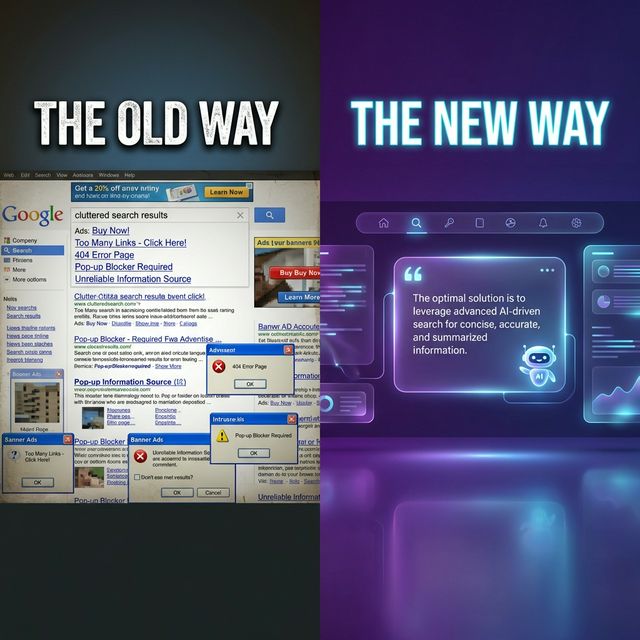
Remember looking for a recipe in 2010? You searched for "best cookie recipe," clicked on a blog called Sally's Baking Addiction, scrolled past 4,000 words about her childhood autumns in Vermont, closed three pop-up ads, and finally found the ingredients list.
Today, you open ChatGPT and type: "Give me a chewy chocolate chip cookie recipe."
And it just... gives it to you.
No scrolling. No life story. No ads. Just the answer.
This shift feels convenient, but under the hood, it is the biggest change to the internet since Google launched in 1998. We are moving from the era of Searching to the era of Asking.
Here is how it actually works, and why businesses are terrified of it.
The "Librarian" Analogy
To understand the difference between Google and AI, imagine the internet is a massive library with billions of books.
The Old Way (Google)
For 20 years, Google has been a Reference Librarian. You walk up to the desk and say, "I need to know about the French Revolution." The Librarian points to Aisle 4, Shelf B and says: "Here is a list of 10 books on that topic. Go read them yourself."
You have to do the work. You have to walk to the shelf (click the link), open the book (load the page), and find the answer.
The New Way (AI Search)
Tools like Perplexity, ChatGPT, and Claude are Research Assistants. You say, "I need to know about the French Revolution." The Assistant says: "On it."
They sprint into the stacks, pull 10 different books off the shelf, speed-read the relevant pages, synthesize the information into a single summary, and hand you a one-page report.
You never have to walk to the shelf. You never open a book. You just get the answer.
Zero-Click Search
•A search query where the user gets their answer directly on the results page and never clicks a link to visit another website.This is called Zero-Click Search. And it is happening everywhere, and it's shifting the way we gather and ingest information.
- The Zero-Click Reality
- 69%of searches now end without a click
- Source: SparkToro / SimilarWeb 2026
How AI Reads the Web (Digital Multitasking)
When you ask an AI a question, it doesn't just look at one website. It does something engineers call "Query Fan-Out," but you can think of it as Digital Multitasking.
If you ask: "What is the best budget camera for travel in 2026?"
The AI doesn't just search that exact phrase. It splits your question into 5-10 sub-questions and searches for them all at once:
- "Top rated budget cameras 2026"
- "Best small cameras for travel photography"
- "Reviews of Canon R50 vs Sony ZV-E10"
- "Battery life comparison compact cameras"
It reads the results for all of these simultaneously, compares the notes, and writes you an answer that says: "The Canon R50 is likely your best bet because..."
It did 10 minutes of research in 3 seconds.
The Four "Search Personalities"
Not all AI models search the same way. They have distinct personalities.
1. Perplexity (The Journalist)
Perplexity is obsessed with sources. It acts like an investigative journalist. It doesn't trust its own memory; it constantly checks the live internet to back up its claims.
- Vibe: Fact-checker, serious, citation-heavy.
- Best for: "What happened in the news today?" or "Find me a study on X."
2. ChatGPT (The Smart Friend)
ChatGPT is like that friend who has read everything but sometimes misremembers the details. It relies heavily on its internal training (books it read last year) and uses the internet only when it needs to "check its phone" for up-to-date info.
- Vibe: Conversational, creative, confident.
- Best for: "Help me plan a trip" or "Explain this concept simply."
3. Google Gemini (The Publisher)
Gemini is the "middle child." It tries to give you the answer, but it also really wants you to use Google's other products. It will pull in Google Maps, YouTube videos, and Flight prices directly into the chat.
- Vibe: Helpful, integrated, multimedia.
- Best for: "Find me a flight to London and things to do there."
4. Claude (The Professor)
Claude is the deep thinker of the group. It reads everything—entire books, 50-page PDFs, complex code—and synthesizes it perfectly. It feels less like a search engine and more like a PhD student who has spent all night in the library for you.
- Vibe: Thoughtful, articulate, nuanced.
- Best for: "Summarize this 100-page report" or "Help me write a strategic memo."
Why This Matters
If you are a normal person, this is great. You save time. If you run a business or a website, this is scary—and really important.
A Final Thought: The "Share of Answer"
We used to compete for "Traffic" (getting people to our site). Now, we compete for Mindshare.
It doesn't matter if nobody clicks your link, as long as the AI says: "The best solution for X is [Your Company]."
We are moving from an economy of Links to an economy of Answers. And in this new world, the only thing that matters is being the answer. The practice of optimising for that — Generative Engine Optimisation (GEO) — is now its own discipline, and the sources AI engines cite are increasingly social, not corporate websites.