Generative Engine Optimization (GEO): Why SMEs Need to Learn AI Search
Generative Engine Optimization (GEO) is shifting how businesses are discovered. Learn why being the 'answer' matters more than being the 'link'.
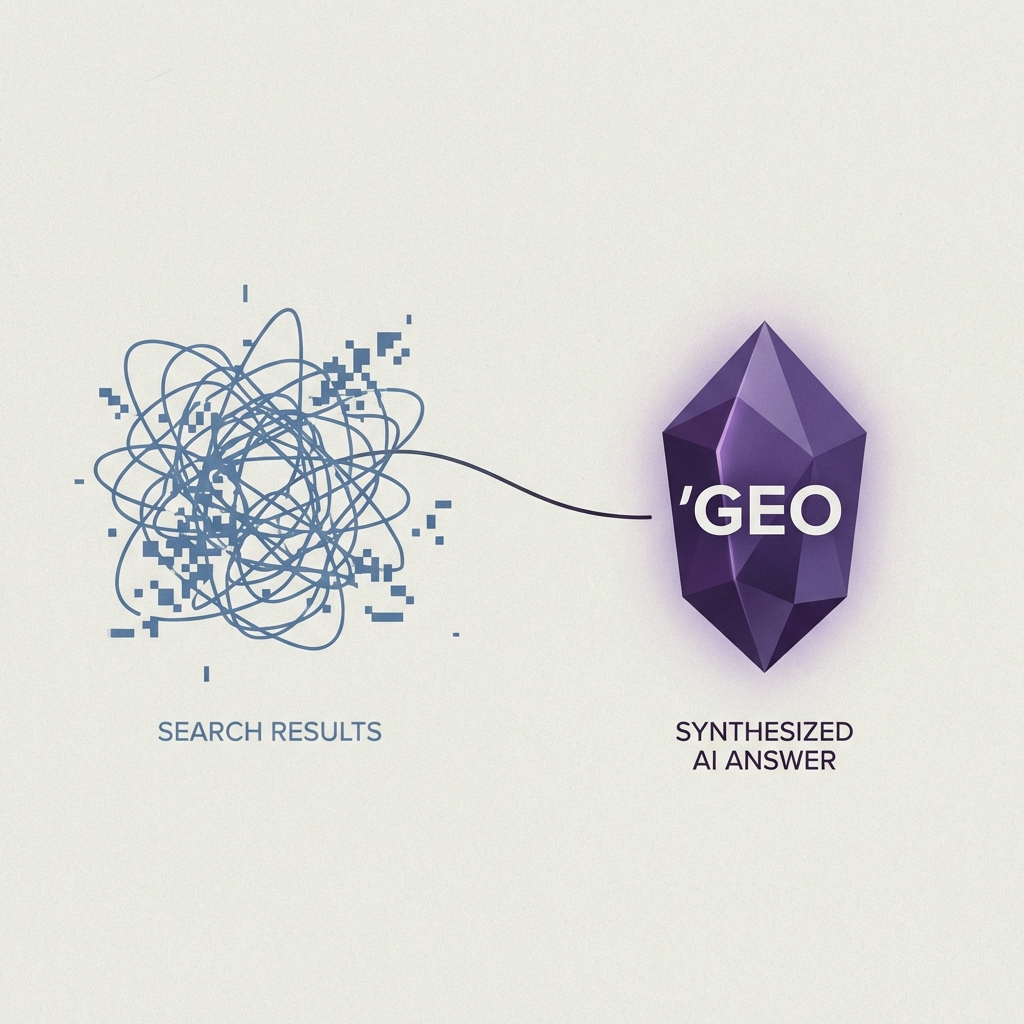
The way customers find businesses is undergoing a fundamental shift. For twenty years, the goal was to rank ten blue links on a search results page. Today, the goal is to be the single trusted answer provided by an AI.
Generative Engine Optimization (GEO)
•The strategic practice of optimizing content to be cited, synthesized, and surfaced by AI Answer Engines (like ChatGPT, Gemini, and Claude) rather than just traditional search engines.The Shift from Links to Answers
For a non-technical business owner, "GEO" might sound like just another acronym. But it represents a change in consumer behavior that is as significant as the shift from mobile to desktop.
In traditional Search, a user types a keyword ("accountant london") and digs through 10 generic links to find a match. It is high-friction and requires the user to do the work.
In Generative Search, the user assigns the work to the AI: "Find me an accountant in London who specializes in Saas and has transparent pricing." The AI then reads data from across the web, synthesizes it, and presents a single, verified recommendation.
The Danger of Lazy Prompts
Users are increasingly using Lazy Prompts because they trust the AI to do the heavy lifting.
- User Types: "Best CRM for small agency"
- AI Computes: "I need to find a CRM that defines itself as 'for agencies', lists 'small business' pricing tiers, and has positive sentiment in Reddit discussions about 'usability'."
If your website is generic Marketing Fluff ("We are world class"), the AI has no data to latch onto. You are invisible.
- Zero-Click Searches
- 58.5%Google searches ending without a click (US, 2024)
- Source: SparkToro & Datos
The metric above illustrates the reality: more and more decisions are being made directly on the results page. The "click" is dying; the "answer" is thriving. (And increasingly the answer is sourced from social, not just websites — see our research on social media as a primary citation source in AI search.)
The Trust Factor (Entities vs Keywords)
Why do consumers trust these AI answers? Because they feel like a consensus. When an AI synthesizes an answer, it cross-references multiple sources and often provides a recommendation that agrees with the user's specific needs.
To be included in that answer, your business needs to establish Semantic Authority. This requires a shift from "Keywords" to "Entities".
- Keywords are strings of text (e.g., "cheap pizza").
- Entities are things the AI understands as real-world objects (e.g., "Tony's Pizza is a Restaurant located in London that serves Pizza").
If your content is just a collection of keywords, you are guessing. If your content defines you as an Entity, you are teaching the AI who you are. This means your content clearly defines what you do, provides hard data, and is validated by trusted sources.
Summary
The transition from Search Engine Optimization to Generative Engine Optimization is about moving from "keywords" to "knowledge." It requires a shift in mindset—viewing your content not just as marketing copy, but as a data source for the world's most intelligent readers.
This is why Rheos is built to structure your business knowledge into semantic data. By automatically organizing your articles, data cards, and definitions into machine-readable formats, Rheos ensures your business speaks the native language of the AI engines that your customers are using today.
Sources & Further Reading
- Gartner: Search Engine Volume to Drop 25% by 2026(2024)view source
- SparkToro: The 2024 Zero-Click Search Study(2024)view source
Related reading
Related Articles
Vibe Marketing Needs a Harness, Not Another Model
YC's harness argument applies directly to marketing. Everyone has the same models now, so the advantage sits in persistent brand state, real publishing rails and a human who approves what goes out.
AI Social Media for Coaches and Consultants: The 2026 UK Guide
How UK coaches and consultants use AI social media tools to win clients without living online. What to post, which tools fit a one-person practice, and real pricing in GBP.
Best AI Social Media Tool UK for Small Business in 2026
Rheos suits UK small businesses needing on-brand AI posts and scheduling at £55/month + VAT; Buffer suits a simple queue. Compare five tools.