Social Media APIs in 2026: Why Distribution Is Still the Hard Problem
Creating content got 1000x easier. Distributing it across Instagram, LinkedIn, TikTok, X, and YouTube did not. A builder's tour of where every platform API breaks down — and where MCP and AI agents actually help.
In the past 18 months, the cost of creating a piece of social media content has collapsed. GPT Image 2 generates a polished branded graphic from a sentence. Sora 2 and Gemini Veo turn a brief into short-form video. A founder with no design skills can produce something that looks professionally made in under a minute. The creation problem, broadly, is solved.
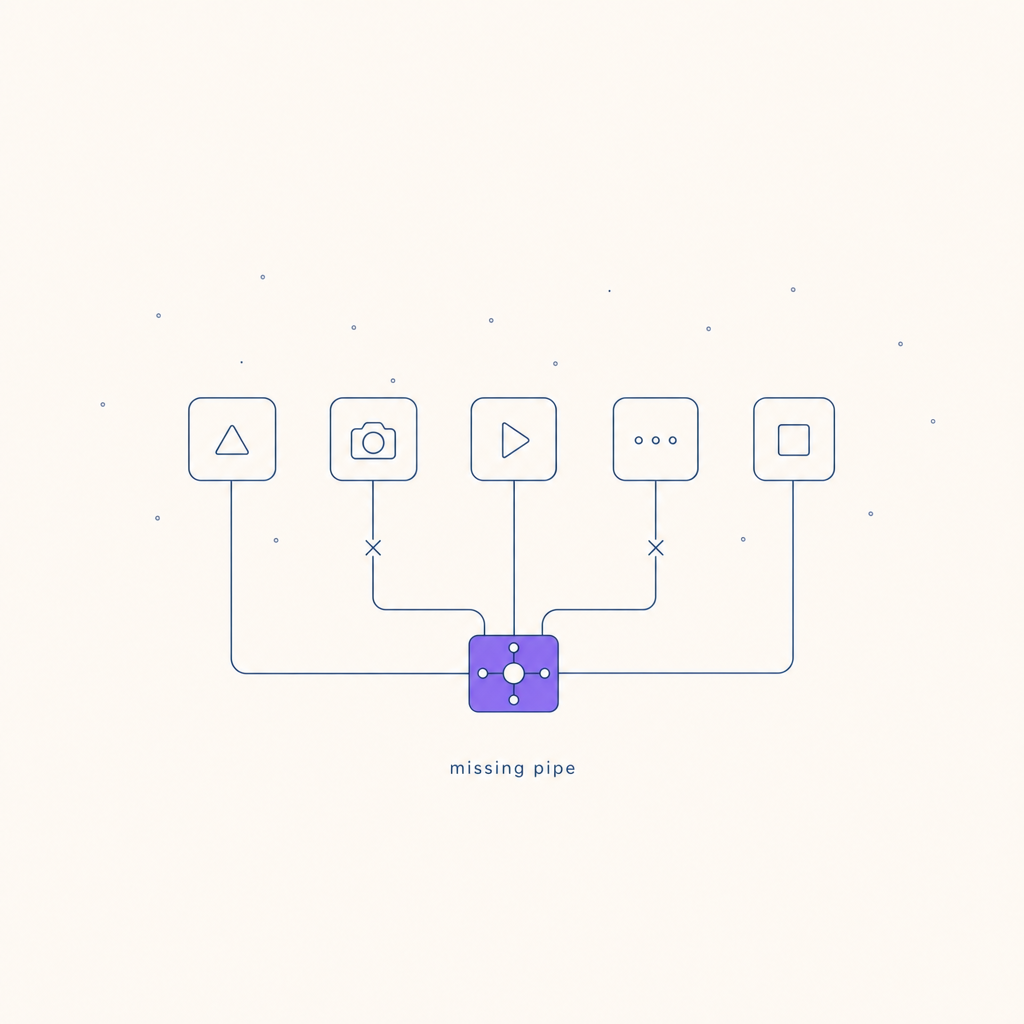
The distribution problem is not. Getting that content onto Instagram, LinkedIn, TikTok, X, and YouTube, in the right format, with the right metadata, at the right time, through a reliable programmatic pipe, is harder now than it was two years ago. The asymmetry is striking: a 99% cost reduction on one side of the pipeline, flat-to-worse on the other.
Why the APIs got harder
The tightening started around 2022 and accelerated through 2024. Platforms had watched third-party apps abuse open APIs for spam, coordinated inauthentic behaviour, and data harvesting. They responded in predictable ways: rate limit cuts, mandatory App Review gates, scope restrictions, and in some cases (LinkedIn) moving entire publishing access behind partner programme approval walls.
At the same time, platforms began investing heavily in their own native creation tools. Instagram launched in-app AI editing. TikTok built a creative studio. LinkedIn added native document carousel tools. When in-app creation is the product, making it easy to post from outside the app is counter-productive. Walled gardens are a business model, not an oversight.
The result: every platform you want to programmatically publish to has a different set of hoops, a different OAuth scope model, and a different set of things that silently break.
The platform-by-platform reality
Here is the current state of each major platform's publishing API, as of April 2026.
| Platform | API Path | Account Requirement | Biggest Gotcha |
|---|---|---|---|
| Graph API v22 | Business or Creator, linked to Facebook Page | Container polling for video; Basic Display API gone Dec 2024 | |
| UGC Posts API | App Review + Partner Programme (3-6 month gate) | URN-based author IDs; monthly versioned headers with breaking changes | |
| X (Twitter) | v2 only | Free tier: write-only, ~1,500 posts/month | Link posts now cost $0.20/call on pay-per-use; API following/likes removed from self-serve |
| TikTok | Content Posting API | Business account; approval for production access | Sandbox only without a partnership application; direct post vs drafts are separate endpoints |
| YouTube | Data API v3 | Any YouTube channel | Uploading a video costs 1,600 quota units; default daily quota is 10,000 units |
| Threads | graph.threads.net | Same Meta app as Instagram | Posts with 5+ links fail with THREADS_API__LINK_LIMIT_EXCEEDED since Dec 2025 |
| Bluesky | AT Protocol | None — open API, app passwords or OAuth | Per-instance rate limits; federated data model adds complexity |
The Instagram Graph API (v22.0) supports single images, carousels (up to 10 items), and Reels. The flow is two-step: POST to /me/media to create a container and get a creation_id, then POST to /me/media_publish with that ID. For Reels, there is a third step: you poll GET /me/media/{creation_id}?fields=status_code until status_code=FINISHED before calling publish. This can take several minutes for larger files, and your code needs to handle the async wait gracefully.
Publishing requires the instagram_content_publish scope, which means going through Meta's App Review process. Personal accounts lost API publishing support entirely when the Basic Display API was deprecated on 4 December 2024. You need a Business or Creator account connected to a Facebook Page.
The Insights API returns engagement data, but with delays: expect 48 hours for full metrics on a Reel. The 200 API calls per hour per user limit is not the constraint that bites most builders; the App Review timeline is.
LinkedIn is the most restrictive platform for third-party publishing. API access now requires joining the LinkedIn Partner Programme, with an approval rate reportedly under 10% and a 3-6 month review window. Without approval, you get consumer-level access only.
Where you do have access, the mechanics are fiddly. Every API request requires a versioned LinkedIn-Version header (currently 202604 for the Marketing API). The UGC Posts API uses URN-formatted author identifiers: personal posts require urn:li:person:{id}, company page posts require urn:li:organization:{id}. Getting the correct URN is a separate API call before you can post. The image upload flow is a multi-step sequence: initialise the upload, PUT the binary to the returned URL, then reference the asset ID in the post creation call.
The Share API (the older /v2/shares endpoint) is effectively superseded by UGC Posts (/v2/ugcPosts). LinkedIn versions its APIs on a monthly cycle and sunsets old versions after a year. The April 2025 version (202504) was sunset in April 2026.
X (Twitter)
X's API has gone through the most aggressive monetisation of any platform since 2022. The Free tier is write-only, capped at roughly 1,500 posts per month, with no read access at all. Basic tier costs $100-200 per month and gives 15,000 reads and 50,000 posts at the app level. Above that, Pro starts above $5,000/month.
The pricing shift that landed in April 2026 is the most punishing for builders: link posts now cost $0.20 per call on the pay-per-use model (up from $0.01, a 1,900% increase), while standard posts are $0.015. API-level following, likes, and quote-posts have been removed from self-serve tiers entirely. If your tool does anything beyond basic text posting, the cost structure has changed fundamentally.
The character limit remains 280 for standard posts on non-premium accounts.
TikTok
TikTok's Content Posting API exists, but getting reliable production access as a third-party tool is genuinely difficult. The API has two main endpoints: Direct Post (publishes immediately) and Upload to Drafts (lands in the creator's draft tray for manual review before publishing). Direct Post requires a higher level of API approval than Drafts.
The sandbox environment exists for testing, but production access requires a partnership application. TikTok's developer portal is the gate, and approval timelines and criteria are not publicly documented in the same way Meta's or Google's are. In our experience building Rheos, TikTok is the platform most likely to be the last one wired up in any multi-channel publishing tool. The engagement numbers justify the effort, but the API friction is real.
YouTube
YouTube Data API v3 is free to use, but quota-bound in a way that catches builders off guard. Each project gets 10,000 quota units per day. Uploading a video costs 1,600 units. That means you can upload six videos per day before hitting your default limit — for a scheduling tool serving multiple users, those units evaporate quickly.
Search operations cost 100 units each, so any feature that lets users search YouTube content alongside publishing is expensive. You can apply through Google Cloud Console for higher quotas, but Google approves requests based on use case and compliance review.
YouTube Shorts is published via the same videos.insert endpoint as regular videos. The platform classifies a video as a Short based on its duration and aspect ratio (under 60 seconds, 9:16). Thumbnail uploads and scheduled publishing are both supported, but each operation has its own quota cost.
Threads and Bluesky
Threads, which reached 400 million monthly active users by Q3 2025, now has a reasonably capable API at graph.threads.net. As of the December 2025 changelog update, posts with more than five links fail with THREADS_API__LINK_LIMIT_EXCEEDED. Polls, location data, and topic tags are all createable via the API. The permissions model mirrors Instagram's (it is the same Meta app infrastructure), which makes it the easiest add-on for any team already integrated with Instagram.
Bluesky's AT Protocol is the outlier: it is genuinely open. Authentication works via app passwords (simpler) or OAuth. Posting uses the app.bsky.feed.post lexicon. There is no app review gate, no partner programme, and no per-post API cost. Rate limits exist per instance, but they are not the aggressive walls you hit on Meta or X. For a platform that is genuinely growing among certain demographics in 2026, the API is a pleasure to work with by comparison.
Why "post once, publish everywhere" tools fail in practice
Even if you have cleared the API access hurdles on every platform, you still have a content reformatting problem that most tools paper over.
Video is the obvious case. Instagram Reels expects 9:16 vertical. LinkedIn favours 1:1 square or 16:9 landscape. TikTok mandates 9:16. YouTube Shorts need 9:16 and under 60 seconds. If you take a single video asset and post it directly to all four platforms, three of them will either reject it, crop it badly, or reduce its reach because the format signals a cross-post. The correct behaviour is to transcode and reframe the asset per platform before upload — which requires FFmpeg or similar, proper aspect ratio handling, and per-platform specification awareness.
Images have the same problem. Instagram's recommended size for feed posts is 1080x1080px (1:1) or 1080x1350px (4:5). LinkedIn wants 1200x1200px for square or 1200x627px for landscape. Getting this wrong does not always produce an error; it produces a poorly-cropped result that the platform serves to fewer people.
Then there is caption behaviour. Hashtags on Instagram benefit from 3-11 targeted tags. LinkedIn works with 3-5 professional hashtags, and keyword-stuffed hashtag blocks actively reduce B2B reach. TikTok captions have a 150-character limit on the video text overlay and 2,200 characters elsewhere. X gives you 280 characters. These are not small differences you can trim around the edges.
The "hidden middle layer" of platform-specific reformatting is where the real engineering time goes. Based on the pattern across tools we have looked at, this layer accounts for 30-50% of total development effort in mature publishing products. It is not glamorous, it is not AI, and it is not the thing that gets demoed. But it is the difference between a tool that quietly fails on half its channels and one that reliably works.
Where MCP actually fits
MCP gets discussed in the context of distribution, and it is worth being precise about what it does and does not solve.
MCP does not touch platform APIs. When you publish via an MCP-enabled tool, the MCP server still has to call Instagram's /me/media_publish, LinkedIn's /v2/ugcPosts, or YouTube's videos.insert on your behalf. The platform API constraints above do not change.
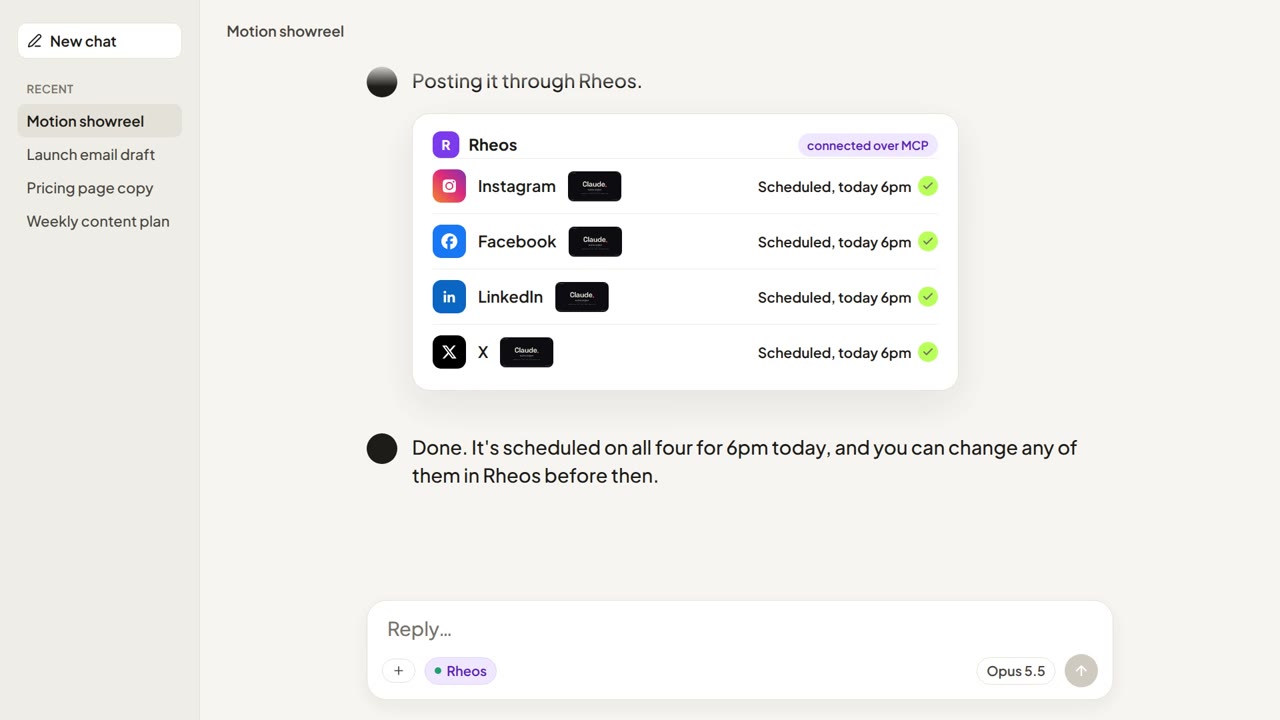
What MCP solves is the ergonomics of invoking those APIs from inside a Claude conversation. Instead of opening a scheduling dashboard, building a post, picking platforms, uploading assets, and hitting publish — you describe what you want in plain English and the tool executes the chain. The API is the mechanism; MCP is the interface.
For builders, this is the trigger layer: MCP exposes the publishing pipeline as something an AI agent can reason about, call conditionally, chain with other tools, and report back on. That is genuinely useful. It is not a workaround for the platform API restrictions.
Where this is going
The honest picture for 2026 is this: the direction is right but we are early.
The architecture people describe — agents that run distribution as a workflow, automatically reformat content per platform, adapt captions per channel's norms, and report back on what landed — is technically possible. The pieces exist. The platform APIs are hostile enough that the agent has to be built around their constraints rather than around a clean abstraction.
What is realistic now: scheduling and publishing with per-platform formatting handled by code, with an LLM layer writing the platform-specific caption variations from a single brief. What requires honest work: video transcoding at scale, reliable error handling when TikTok's production gate rejects a request, and building retry logic that does not result in duplicate posts when LinkedIn's versioned API changes behaviour between months.
What is still hype: fully autonomous agents that discover your content is performing badly on LinkedIn, diagnose why, rewrite the caption, and republish without human oversight. The API rate limits, approval requirements, and content moderation surfaces make that loop fragile in ways that are hard to make reliable.
What we built at Rheos, and where it genuinely falls short
Rheos publishes to Instagram, Facebook, LinkedIn and X, including video: Reels on Instagram, chunked uploads on LinkedIn and X. Rheos does not make the video itself; you bring it. The MCP server exposes the current publishing flow as a set of tools Claude can call directly from a conversation.
What we have not solved: Rheos does not post to TikTok or YouTube today, for the access and quota reasons above. The video reformatting layer is not as automated as it should be,.
Saying so is not a liability: it is the accurate picture of where a product at this stage sits. The platforms make this hard. Every team building in this space is dealing with the same walls. The difference between tools that work and tools that quietly fail is whether the builder has been honest with themselves about where the gaps are. For more on why getting content reliably onto these platforms matters more than ever, see our research on social media as a primary citation source in AI search.
Sources
- Meta Instagram API Updates (April 2026): https://developers.facebook.com/blog/post/2026/04/22/instagram-api-updates-for-partnerships-metrics-collaboration-and-engagement/
- Meta Instagram Graph API reference: https://www.keyapi.ai/blog/instagram-basic-display-api
- LinkedIn Marketing API versioning: https://learn.microsoft.com/en-us/linkedin/marketing/versioning?view=li-lms-2026-04
- LinkedIn API access guide: https://connectsafely.ai/articles/linkedin-api-complete-guide-2026
- LinkedIn publishing flow: https://www.postpeer.dev/blog/how-to-post-on-linkedin-with-api
- LinkedIn Partner Programme access requirements: https://www.unipile.com/linkedin-api-a-comprehensive-guide-to-integration/
- X API pricing changes April 2026 (link post costs): https://gigazine.net/gsc_news/en/20260422-x-api-link-price-up/
- X API tier comparison: https://data365.co/blog/twitter-api-11
- YouTube Data API v3 quota costs: https://turbotechies.com/youtube-instagram-api-pricing-what-the-docs-dont-tell-you-2026/
- YouTube API quota documentation: https://www.getphyllo.com/post/is-the-youtube-api-free-costs-limits-iv
- Threads API changelog: https://developers.facebook.com/docs/threads/changelog/
- Threads API capabilities 2025: https://embedsocial.com/blog/instagram-threads-app/
- Cross-platform reformatting engineering effort: https://influenceflow.io/resources/staying-updated-on-influencer-platform-policies-a-creators-complete-guide-2026/
- TikTok Content Posting API overview: https://www.getphyllo.com/post/social-media-api-guide-on-top-apis-for-developers
Related reading
Built for your kind of business
Rheos plans your social media and drafts the first version of every post. You edit and approve, and it goes out on time.
It learns your brand, voice and style.
From your website and your posts, it picks up how you sound and what you stand for.
Rheos
Social media marketing for small businesses, without the admin.
- Small business owners
- Founders doing their own marketing
- Marketers in small teams
Direct and plain. Talks to owners as peers, in British English.
Plus Jakarta Sans
Read from rheos.app and @rheosapp
A plan to reach small business owners.
It works out where small business owners, founders doing their own marketing and marketers in small teams look, and plans the week around them.
Ideas from what is going on at your business.
This week: five-minute routine, customer story, tip of the week. It turns each into a post idea you can edit, with images from your library.
Out on LinkedIn and the rest.
“Five minutes a day is enough” and the rest of the week, scheduled across Instagram, Facebook, LinkedIn and X from one calendar.
See what worked for your business.
Which posts got seen, grew the following and turned into customers. That feeds straight back into next week's plan.
You can try it free for 10 days, no card needed. Then £55/month including VAT.
Archie Roberts
Archie Roberts is the founder of Rheos, which plans social media for UK small businesses and drafts the first version of every post for the owner to edit and approve. He writes about how small business owners can show up where their customers look.
Related Articles
Can Claude Schedule Instagram Posts? Yes, Once It's Connected
Claude can't post to Instagram on its own. Connect a publishing tool through MCP and it can schedule posts, carousels and Reels. The three ways to connect it, and what each one asks of you.
You Can Make a Video with Claude Now. Here's How to Post It
Claude Code can write and render a finished video. It can't post one to Instagram, Facebook, LinkedIn or X on its own. The three ways to get it posted, and how to go from render to scheduled post with Claude still in the loop.
Buffer or Later? Which Scheduler to Pick in 2026
Buffer or Later: pick Buffer if you post to X or want a free plan, pick Later if Instagram is your main channel. Later dropped X in August 2025.